Hazelwood
Hazelwood
Brew House
Brew House
The Chronological History of the Hazelwood Brewing Company and its successors
1905-1920
Hazelwood Brewing Company
1933-1934
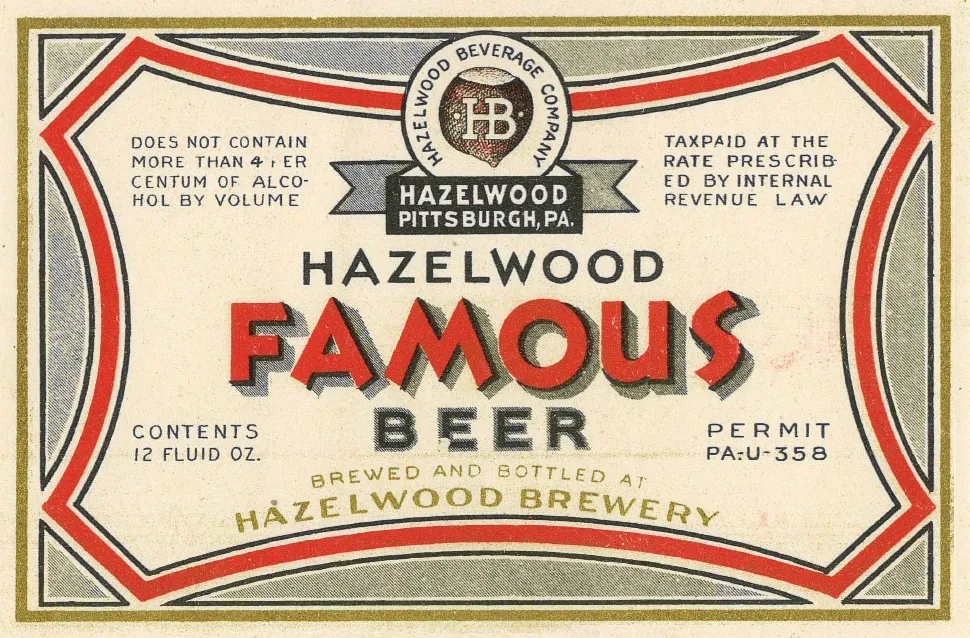
Hazelwood Beverage Company
1934-1938
Derby Brewing Company
The Ice House
The ice house was originally constructed in 1905 as a one-story, L-shaped, brick masonry building that had a hip roof with a “lantern roof” on the western end of the hip roof. In ca. 1953, the leg of the ell was demolished for expansion of the adjacent steel drum manufacturer. At an unknown time, most probably between 1979 and 1995, the hip roof and clerestory were removed, and a corrugated metal panel shell was constructed within the remaining four walls, so that the corrugated metal roof overhangs and protects the remaining four masonry walls.

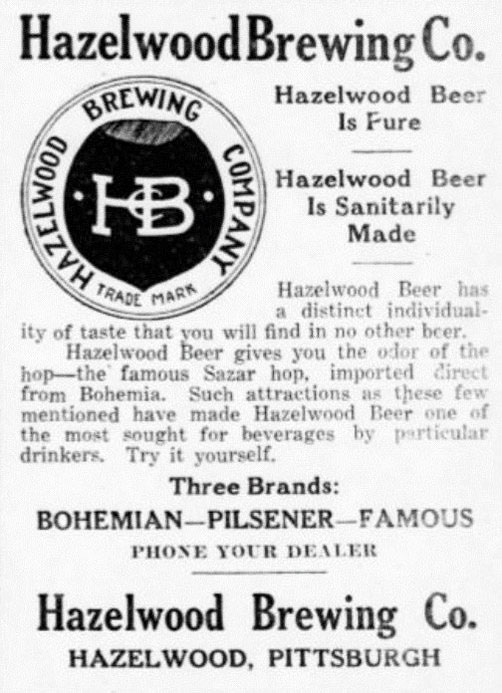
Hazelwood Brewing Company Ads


Hazelwood Brewing Company Timeline
1904
The Hazelwood Brewing Company was legally established by the United Ice & Supply Company on July 14. Construction of the brewery was begun immediately at a site adjacent to United Ice & Supply Company’s existing ice manufacturing building on Gloster Street. The brick walls of the original one-story ice manufacturing building still stand on the neighboring property to the east of the Hazelwood Brew House.
1905
Before construction on the brewery was complete, the United Ice & Supply Company legally merged with the brewing company and thereafter both business functions operated under the management of the Hazelwood Brewing Company (HBC).
1905
Construction was estimated to have cost $200,000 using plans from the Viltor Manufacturing Company of Milwaukee, Wisconsin, makers of refrigeration equipment and compressors.
1905
When the brewery was complete, the complex of buildings included the brewery building, an ice house, a bottling building, and an office. The brewery was built as a modern “gravity fed” brewery, with all beer production equipment vertically stacked on three floors. The core of beer production was the grain mill on the 3rd floor, mash tun on the 2nd floor and the brew kettle on the ground floor. This core equipment of beer production for was set in the southern bay (Bay 3) of the building. The walls in Bays 1 and 2 of the remaining building were used as cellars to age the beer and lined by 4” thick cork panels for insulation.
1905
Brewery production capacity was 40,000 barrels annually, but varied year-to-year.
1905-1913
The brewery produced three varieties of “the Best Beer Ever Brewed”—Pilsener, Bohemian, and Famous lager—touted for their quality and purity of ingredients. The brewery developed strong regional demand in western Pennsylvania.
1907
During a period of brewery consolidations in Pittsburgh, HBC remained an independent brewery. HBC preserved the practice of smaller scale brewing for a local market and was not controlled by the management, pricing, production, or labor policies of the conglomerates. For example, in 1907 the Brewery Workers Union struck after the conglomerates stalled negotiations over wages and hours, idling over 1500 workers and twenty-four Pittsburgh area breweries. HBC broke with the Brewers’ Association and settled with the union separately, reopening the brewery and resuming production while the conglomerates’ breweries remained closed.
1913
As HBC’s business grew, the owners added more cellar space to age the beer being produced. Several wood-frame additions were added onto the east (rear) elevation. In 1913, a fire in an adjacent building damaged these same, newly constructed wood frame additions.
1913
A brick addition was added to the north side of the building to replace the space lost in the fires. This brick addition is now occupied on the 1st and 2nd floors by Abstract Realm Brewing.
1916
The Industrial Directory of Pennsylvania recorded 54 employees for the Hazelwood Brewing Company, 50 for Fort Pitt Brewing Company in Sharpsburg, 38 at Tube City Brewing Company in McKeesport, and 46 for the Anchor Brewing Company in Breckenridge.
1919
Restrictions on brewing and alcohol production by the federal government during World War I already posed a challenge to brewers, and the substantial drop in the number of employees at HBC between 1916 and 1919 suggests that the company had already scaled back production.
1919
After the Pittsburgh conglomerates organized, they shut down breweries considered redundant or inadequately profitable. By 1919 the Industrial Directory of Pennsylvania recorded only five Pittsburgh Brewing Company breweries. The Independent Brewing Company immediately closed two breweries and retained only ten breweries.
1919
The National Prohibition Act ratified the 18th Amendment to the Constitution which banned the sale, transportation, and manufacturing of alcohol in the United States. The Volstead Prohibition Enforcement Act was passed in October 1919.
1920
Enforcement of National Prohibition began on January 19, 1920, and remained the law of the land until the 18th Amendment was repleaded by the 21st Amendment on December 5, 1933.
1920
To sustain the business, the company was renamed the Hazelwood Beverage Company which made cereal products and near beer. Near beer (<3% ABV) was produced by brewing regular beer and then removing the alcohol, a slippery circumstance regarding stocks of real beer and their possible disposition. The brewery did in fact have a license to brew beer: Pa U-358. The Brew Master at the time was Oscar E. Hammer.
1920-1922
During Prohibition, HBC retained its liquor license to lawfully produce cereal beverages (near beer).
1922
The brewery property was sold to Daniel Sutter, formerly the brew master for the Tube City Brewing Company of McKeesport, Pennsylvania, for $208,000; Sutter retained the company name and continued operations. This substantial amount suggesting that the purchaser considered it to be viable operation.
1922
Whether the new owner, Daniel Sutter, had connections to any organized crime group or simply decided to make easy money, is not known. Two small newspapers items hint that a HBC officer tried for bribery, Morris Friedman, did have some shady connections. Friedman was arrested in 1922 as an officer of the Westmoreland Brewing Company for violating a court injunction to cease brewing. Morris Friedman’s antics did not end, in 1937 he was arrested for operating an illegal gambling boat on the Youghiogheny River.
1922
HBC became entangled with the Pittsburgh office of the Bureau of Prohibition Enforcement. HBC was the only City of Pittsburgh brewery to be raided by Prohibition enforcement officers. Protection rackets operated by the police and by various gangs were notorious in Pittsburgh. The brewery may have failed to pay the proper protection. On December 13, 1922, Treasury agents stopped two trucks loaded with 40 barrels of real beer, which they claimed had been loaded at the HBC. Being denied entrance to the brewery, they returned the next day with search warrants to investigate the operations and books of the HBC, and on December 20, 1922, they padlocked the building.
1923
In January, a judge ordered the property released to its owner on the payment of a $5,000 bond. In April of that same year, Treasury agents staged another raid, impounding 4,757 barrels worth of beer in the brewery vats; in turn, the HBC filed a petition claiming illegal seizure, and in May the brewery was released.
1923
Yet another raid was undertaken, involving 3,835 barrels of beer. In July, Treasury agents padlocked the building again, and filed contempt of court charges against the owner and employees, as well as a writ of forfeiture for the beer and buildings.
1923
A final raid in August included the arrest of eleven employees, the entire work force present in the building at the time.
1924
HBC also got caught up in a sting operation run by federal prohibition agents. A federal grand jury convened in Erie, Pennsylvania, considered indictments against Elmer Hawker, chief of the Pittsburgh federal Prohibition enforcement office; John A. Friday, an officer of the Duquesne Brewing Company; and Morris Friedman, an officer of HBC, for conspiracy to violate the Volstead Act. The jury ignored the charges against Friday but returned indictments against Hawker and Friedman for conspiring to pay federal agents $25,000 to “overlook violations of the prohibition laws by a number of breweries”. Morris Friedman’s trial began on December 15, 1924. The jury declined to believe the prosecution and the defendant was acquitted on December 18, 1924.
1925
On February 10, the US Government took Hazelwood Brewing Co. to court for violating Section 25 of the National Prohibition Act. A government raid at 3 am found 3,835 barrels of beer, large amounts of hops and brewing equipment. The beer was measured at 4% ABV. After the appeals case was lost, the beer was destroyed by the government. Brewing was legal during prohibition. But it had to be brewed or reduced to a lawful content of just 3%.
1925
A federal court upheld the seizure and destruction of the beer but prohibited the destruction of the buildings and other materials. There is no record that the beer was destroyed, although having sat in its vats for two years would have had the same effect. The HBC and employees were charged with nuisance in 1926, and eventually two of the employees were assessed with $25 fines. There is no record to indicate if the brewery resumed production of any beverages.
1926
In May, a New York Congressman, Fiorello LaGuardia, complained to Secretary of the Treasury, Andrew Mellon, that it was “common knowledge in the City of Pittsburgh that the Hazelwood Brewing Company is running full blast and that real beer is flowing from the vats as fast as mature brewing and the law of gravitation will permit.” An agent at the Pittsburgh federal Prohibition enforcement office, Frederick Baird, responded that “the Hazelwood brewery had been absolutely idle for a couple of years.”
1930
The brewery property was sold at Sheriff’s Sale to the Hazelwood Savings and Trust Company.
1933
The National Prohibition Act was repealed in December. A short notice in the newspaper mentioned the refinancing plans of regional brewing companies in preparation for the end of Prohibition noted that the Hazelwood Brewing Company plant “has been kept in production shape and is ready to turn out legalized beer as soon as the new beer bill becomes effective.”
1933
With the repeal of Prohibition, full brewing operations began again. In 1933, Hazelwood Brewing Company reorganized and changed the word “Brewing” in the company name to “Beverage”. The new organization, the Hazelwood Beverage Company with a $100,000 stock offering was oversubscribed. The Hazelwood Beverage Company then bought the property back from Hazelwood Savings and Trust Company for $1. The new HBC organized a series of celebrations, including a “free beer night” extravaganza at the Summit Hotel in Uniontown, Pennsylvania.
1933
Under its new name, the Hazelwood Beverage Company, the company brought back the original Companies named beers of Hazelwood Beer, Hazelwood Porter. It also added several new brands such as Hazelnut Ale under the direction of brew master Emil Gaertner.
1934
Although the institution was able to reopen following Prohibition, the new Hazelwood Beverage Company saw little success and by June declaring bankruptcy on June 18.
1934
The closed brewery was once again sold. On November 30, 1934, Ralph Chantler paid $71,000, assumed the $50,000 mortgage, and invested $200,000 in renovations.
1934
The brewing company was organized under the name the Derby Brewing Company and the brewery reopened with a grand parade. Derby Brewing Company claimed a marketing area that covered western Pennsylvania, eastern Ohio, and northern West Virginia.
1935
Derby Brewing Company had Permit Number PA-G-213 and produced and sold beer names including:
- Moerlein Bock Beer: 1934 – 1938
- Moerlein Pilsener Beer: 1935 – 1938
- Moerlein Lager Beer
- Old Coach Ale: 1935 – 1938
1938
Despite moderate success and extensive local marketing, it did not prosper. The Derby Brewing Company declared bankruptcy in 1938, the property was sold, and the equipment dismantled.
1950
A Notice was posted for Sheriff Sale for the Derby Brewery, aka the Hazelwood Beverage Co. in The Pittsburgh Post, September 2, 1950, for unpaid school tax of $5,500. Charles A. Paterson was owner or reputed owner.
1952-1957
The bottling building was demolished by 1952, and by 1957, the small addition of the old brick Ice House had been removed.
1998
On June 2, a tornado with 110 MPH winds tore across Pittsburgh, damaging properties on Mount Washington and throughout Hazelwood. There was significant damage to the old brewery complex. The ornate 4th floor wing above the south bay, was knocked down and its tons of bricks fell onto several 2-story additions on the rear of the building where the present-day beer garden exists. The tornado also ripped off large sections of the ornate roof-line parapet on several parts of the building. The damage caused by all the falling material onto the 2-story additions would require their demolition.
1999
The owners of the brewery building at the time of the tornado were, James and Janice Palmer. The cost for the demolition of the additions and repairs to the damaged upper floors of the old brewery following the tornado were so extensive, they felt that the building was not worth repairing and sold the building for $1.00 to the demolition contractor, Victor “Vic” Lapaglia, owner of LACO Demolition.
2000
Vic took on the demo work and did modest repairs. He used the old brewery for storage, warehousing of his Demo business.
2018
Vic Lapaglia, of LACO Demolition, graciously sold the old Hazelwood Brewery building to The Progress Fund. This enabled Vic to close his demolition company, retire and care for his ill wife. The old brewery property was the first The Progress Fund purchased as part of a property assemblage plan to revitalize the Historic Brewery site and surrounded Industrial zoned properties.